
Chelsea Drinkard No Comments

7 Questions Every CEO Should Ask Before Renewing an Office Lease

For many businesses, renewing an office lease feels like the easiest option. You know the building, your employees know the location, and moving can seem disruptive.

But convenience is not always the most strategic decision.

Before signing a renewal, CEOs should pause and ask whether their current office still aligns with the company’s goals. A lease renewal is one of the few opportunities to reduce occupancy costs, improve workspace efficiency, and negotiate better terms.

Here are seven questions every business leader should consider.

1. Does our current space still support our business?

Many companies have changed dramatically over the past few years. Your office should reflect how your team works today, not how it operated five years ago.

2. What is the market offering?

Without comparing competing properties, it is impossible to know whether your renewal proposal is competitive. Landlords expect informed Tenants to evaluate alternatives. You always what to discuss with a Broker who can provide a market survey of available space, asking rents and provide their feedback on what they are seeing as market standards with negotating renantal rates, free rent, Tenant Improvement Allowance other financial levers.

3. Have operating expenses increased?

Rent is only one piece of your occupancy cost. Operating expenses, insurance, and property taxes can significantly impact your overall budget. Renegotiating the Base Year and a cap on controllable operating expenses, can assist in mitigating any increases over the renewal lease term.

4. Could we negotiate better concessions?

Tenant Improvement Allowances, free rent, parking, signage, and expansion rights are all negotiable when you have leverage.

5. What are our growth plans?

A lease should accommodate your future, not limit. Consider hiring plans, technology needs, and operational changes before committing to another long term agreement.

6. When should we begin?

Ideally, twelve months before lease expiration. Early planning creates leverage and gives you access to the broadest range of options.

7. Are we making a real estate decision or a business decision?

The best office decisions are driven by business strategy. Real estate should support recruiting, client experience, company culture, and long term growth.

Renewing your lease may absolutely be the right decision. The key is making that decision after evaluating your options, not before.

The companies that consistently negotiate the best outcomes are rarely the ones reacting to deadlines. They are the ones planning ahead and using market knowledge to their advantage.

Chelsea Drinkard No Comments

What CEOs Are Asking About Tampa Bay Office Real Estate Right Now Part 2 of 2

As Tampa Bay continues to attract businesses and talent, companies are making increasingly deliberate real estate decisions. The conversations happening today go beyond leasing and purchasing. They are centered around timing, positioning, and long term impact. You can read our Part 1 here.

5) One of the most important questions CEOs are asking is where companies are relocating within the region. Submarkets like Westshore, Downtown Tampa, Midtown, and Downtown St. Petersburg are seeing continued movement as businesses seek proximity to talent, amenities, and infrastructure. Location is no longer just geographic. It is a competitive advantage.

6) At the same time, owners and investors are evaluating whether now is the right time to sell. While demand remains, buyers are more selective and underwriting is more disciplined. This has created a market where preparation, financial clarity, and strategic timing directly influence outcomes.

7) Timing is also critical for Tenants. Companies that begin their search early maintain control of the negotiation and access to the best opportunities. Those that wait often find themselves making reactive decisions with limited leverage.

8) Many leaders are questioning which buildings will remain relevant. The answer is increasingly tied to quality, experience, and adaptability. Older, underinvested assets face greater challenges, while well positioned properties continue to outperform. The ones we are seeing performing the best in Tampa Bay in Midtown, Westshore Business District in Tampa, Downtown Tampa and Downtown St Petersburg.

Ultimately, the future of office space in Tampa Bay is not uncertain. It is evolving. Businesses that approach commercial real estate with intention and strategy will continue to gain an advantage.

The companies that win are not simply choosing space. They are aligning their real estate with where they are going next.

Chelsea Drinkard No Comments

What CEOs Are Asking About Tampa Bay Office Real Estate Right Now Part 1 of 2

Tampa Bay’s office market continues to evolve, yet one thing remains consistent: decision makers are asking smarter, more strategic questions before committing to space.

1) One of the most common questions today is whether the region is running out of quality office space. The reality is not a shortage, but a shift. Companies are consolidating into higher quality buildings that better reflect their brand, culture, and long term vision in areas such as Downtown Tampa and Westshore Business District. As a result, the best spaces in these submarkets are leasing faster, and often at a premium.

2) At the same time, leaders are reevaluating whether to lease or buy. This decision is no longer just about occupancy. It is about capital allocation, flexibility, and long term positioning. In some cases, ownership creates wealth and stability. In others, leasing preserves liquidity and allows for agility.

3) Another area of focus is cost. Many executives initially look at rental rates, but quickly realize that operating expenses, property taxes, and insurance significantly impact total occupancy cost. Understanding these variables early can prevent costly surprises later.

4) Perhaps the most discussed topic is space utilization. Hybrid work has changed how companies think about square footage. The question is no longer how much space per employee, but how space supports collaboration, productivity, and growth.

What this all signals is a more sophisticated approach to real estate. CEOs are no longer viewing office space as a fixed expense. They are treating it as a strategic lever that influences talent, brand perception, and financial performance.

Those who ask the right questions early are the ones who create the most value from their real estate decisions.

Chelsea Drinkard No Comments

What I Wish More People Knew Before Leasing Office Space in Tampa Bay

If there’s one thing I’ve learned after 10+ years in commercial real estate:

Most companies don’t realize how much their office lease impacts their bottom line.

Whether you’re opening your first office or relocating your headquarters, here’s what I wish every business leader knew before making their office decision:

Your lease is more than a lease agreement, it’s a business strategy.

A lease shapes your cash flow, flexibility, and company culture. Before touring a single property, get clear on your growth plan, hiring goals, and space needs. Here are a few considerations: Where do majority of your talen pool lives? What is demographics of those you plan on hiring? How do you want your team to ulitize the office space? The right lease supports your vision and just your square footage.

Square footage can be deceiving.

Two offices might both be 5,000 square feeet but one could feel half the size. Why? Layout efficiency, column spacing, and what counts as usable vs. rentable square footage. Knowing the difference between the useable and rentable with give the answer to why one “feels” bigger. Rentable square feet has a common area factor included for the shared common areas such as elevators, restrooms, stairwells, stairwelss and Tenant ammentities like conference rooms. Multistory buildings you see in Westshore, Downtown St Petersburg and Downtown Tampa area rentable buildings. Useable includes a space has their own entrance directly into the Suite, restrooms inside and does who have any shared common area space.

Watch the hidden costs

Your “base rent” is just the beginning. Operating expenses (CAM, taxes, insurance, janitorial, parking) can swing your total cost dramatically. Even in Full Service leases, there is still expenses a Tenant can be responsible before in the event the Operating Expenses surpass the Tenant’s bse year. Negotiate caps on increases or base year structures to protect your budget.

Timing is everything in Tampa’s market.

In submarkets like Westshore, Downtown, and Midtown, prime space goes fast especially for custom build outs. Start early (ideally 9–12 months before your lease ends).The earlier you plan, the more leverage you have.

Flexibility and lowest rent are not synonymous.

Shorter terms can give your business the flexibility it needs and worth the premium you pay when your company’s future is uncertain during growth mode. Making sure your lease grows with your company is important with first right of refusal to adjacent space that might come available, having favorable sublease terms and etc.

Representation matters.

Landlords have Brokers working for them, you should too. enant Representation Broker advocates only for your interests, helping you uncover hidden opportunities, negotiate better terms, and avoid costly oversights. Here’s the secret: Landlords pays Tenant Representative broker’s fee.

Final Thought

Leasing office space isn’t just about location or price, it’s a business decision that directly and indirectly impacts a company’s bottom line. A great space supports your growth, inspires your team, and strengthens your bottom line.

If you’re planning to lease or renew in Tampa Bay, let’s talk.
Even a 15-minute strategy chat can save you months of stress and thousands of dollars.

Chelsea Drinkard No Comments

3rd Quarter 2025 Tampa Bay Office Market Report and Forecast

Economic Performance & Employment Trends:

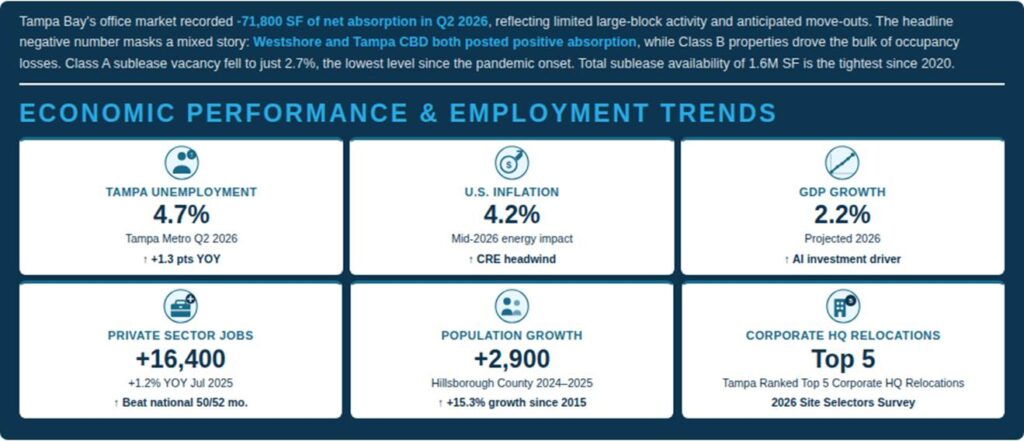
  • Although Tampa Bay’s unemployment rate increased to 3.9% in Q3 and is up from 3.5% from Q3 2024. Still falls below the national rate of 4.3%.
  • “FloridaCommerce announced that the Tampa metro area added 16,400 jobs (+1.2%) in the private sector over the year in July 2025 and has exceeded the national rate for 50 of the last 52 months,” FloridaCommerce.
  • “The area gained the third-highest number of private sector jobs and led the metro areas in job gains over the year in July 2025 in manufacturing, adding 1,600 jobs. Industry gaining the most jobs over the year in the Tampa metro area was education and health services, adding 5,600 jobs” says FloridaCommerce. 
  • Inflation Rate was up 2.9% as of August 2025 over the past year via the US Bureau Labor Statistics. 

Key Metrics in the Office Market:

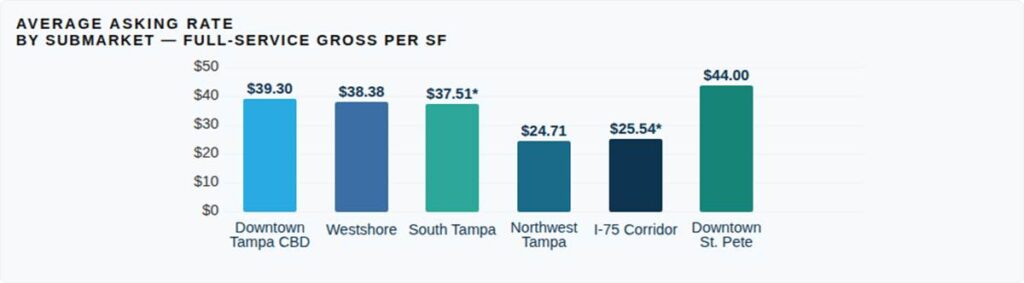
  • Tampa Bay’s average asking rents over all classes have climbed again and hit a record high,  Approx. 3.0% year-over-year, driven primarily by a 5% increase in Class A rates, compared to just a Approx. 2% bump for Class B assets. The pricing differential between urban and suburban Class A properties continues to widen.
  • Consistent with Q2, majority of leasing occurred in Class A buildings with over 65% of the activity, reflecting the preference of quality building by Tenants
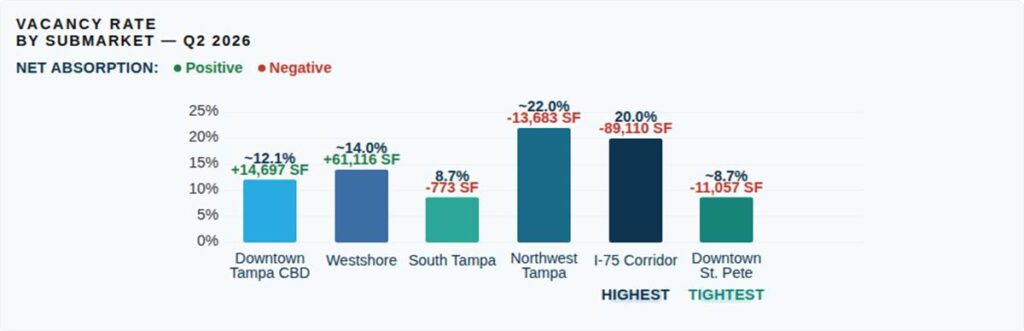
  • Overall vacancy ended at +/- 18.9% with Class A buildings at +/- 14.6%
  • Q3 ended in positive absorption of +/- 200,000 SF, for the second consecutive quarter with a minimal negative absorption in Q1.

Let’s Talk Rent Numbers:

SubmarketOverall Average Asking Rent-All ClassesOverall Asking Rent Class A
Westshore$37.89 Sq. Ft.$43.88  Sq. Ft.
Downtown Tampa$43.13 Sq. Ft.$45.62 Sq. Ft.
Northwest Tampa$26.28 Sq. Ft.$27.56 Sq. Ft.
South Tampa$43.00 Sq. Ft.$52.00 Sq. Ft.
I-75 Corridor$25.78 Sq. Ft.$26.05 Sq. Ft.
Downtown St. Petersburg$41.02 Sq. Ft.$45.69 Sq. Ft.

New Construction Pipeline:

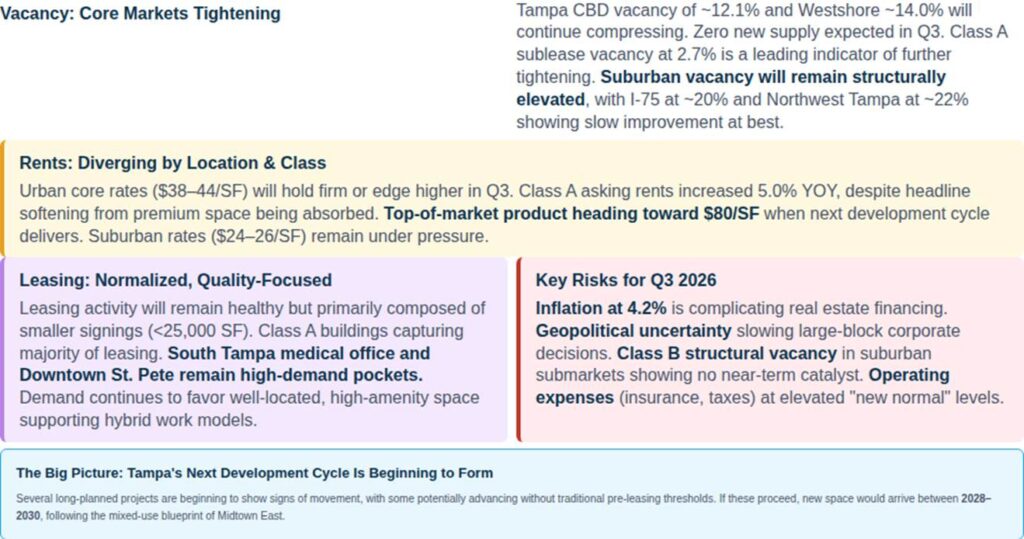
  • Midtown East: The first New Class A building built since 2021 which is 131,790 SF and the second phase of Midtown Tampa, mixed use project located in the heart of Tampa. Since its deliver, 60% vacancy remaining. Midtown East  delivery was part of the reason of the vacancy increase in Westshore during 2nd Qtr. which improved in the 3rd Qtr.
  • Ybor: 92,530 SF for Grow Financial in Ybor broke ground in 2nd quarter where Grow Financials new headquarters will be located from i-75 area.

2025 4th Quarter Forecast:

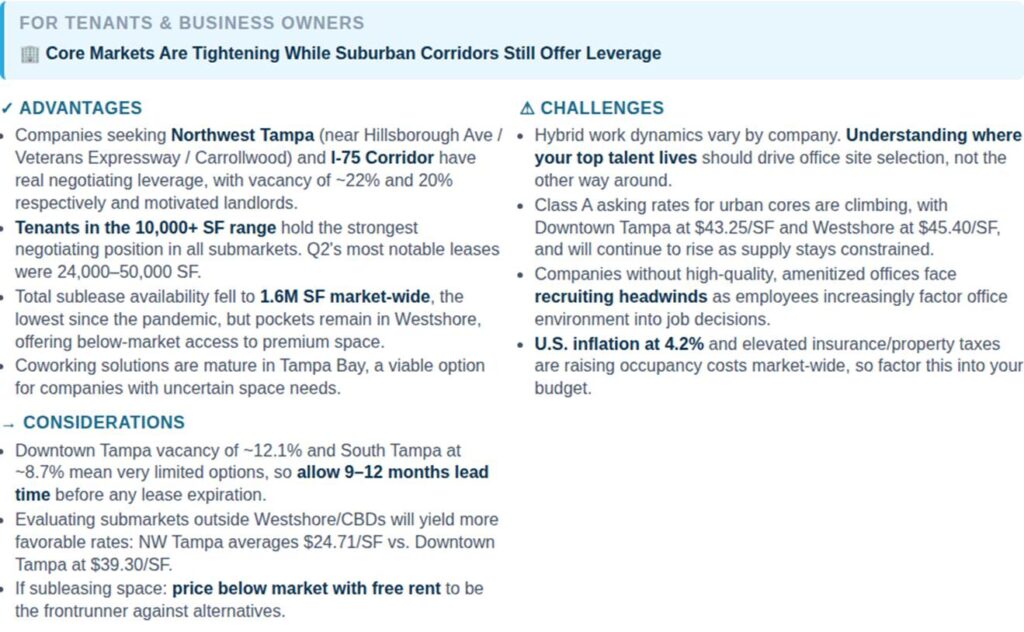
What does this mean for Tenants?

Advantages:

  • Companies who desire to be in suburban areas such as Northwest Tampa in near Hillsborough Avenue/ Veterans Expressway and Carrollwood and I-75 Corridor,  have more negotiating leverage on rental rate and lease concessions due to the higher vacancy rates in buildings.
  • Tenants in the 10,000 + Square Foot range have a stronger position across all Submarkets when negotiating with Landlords. Especially with the most notable leases in the 3rd quarter were 10,000 SF-25,000 SF

Challenges:

  • Every industry is different and every company is different when determining hybrid work schedules [if any]. Gaging top performing employees and where the most ideal employees you plan on recruiting live, will assist office site selection.
  • Class A rents across all submarket will continue to increase as supply tightens.
  • Companies who have part time or full time office policies and do not have their office among highly amenitized and quality buildings,  could negatively impact recruiting abilities for employees to seek more favorable location and atmosphere if they are required to be in office.

Considerations:

  • Due to low vacancy in a submarket like Tampa CBD, allow plenty of lead time before a lease ends is vital when considering a relocation or expansion.
  • Evaluating submarkets outside of Westshore or Tampa CBD, will provide more favorable rental rate and lease terms. 
  • If Tenants are finding themselves in place of uncertainty for their office space, Coworking solutions have become very common in Tampa Bay, providing a mix of individual offices and conference rooms to be used for monthly and quarterly meetings.
  • Tenants who want to subleasing their space, positioning the space below market rent and free rent will position the space to be the frontrunner with competitors. 

What does this mean for Landlords?

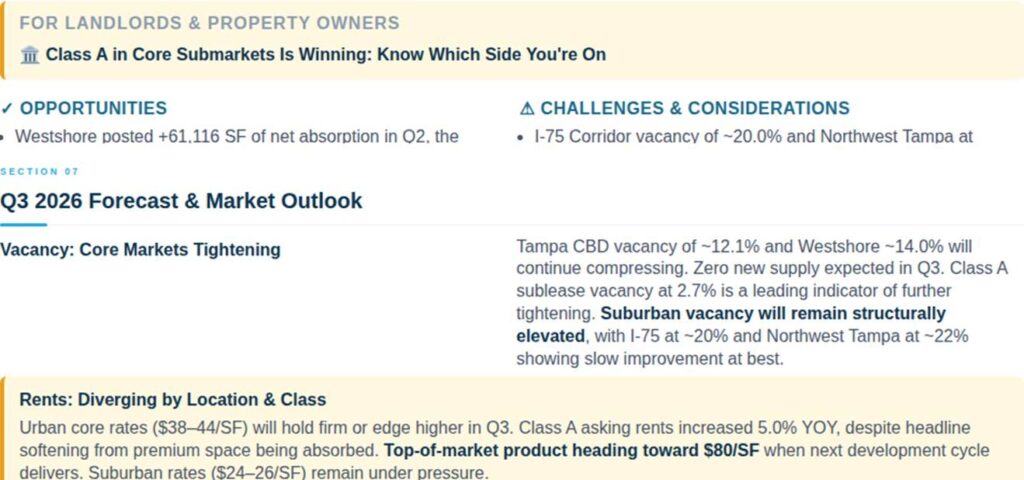
Opportunities:

  • Class A buildings are experiencing the most leasing activity. If a building is not Class A, consider adding features Tenants find valuable.
  •  Outlying areas such as Northwest Tampa and outside of Westshore and the CBDs, have the opportunity to capture Tenant’s who have been priced out.

Challenges:

  • Buildings located in suburban corridors like the Northwest and i-75 are experiencing the highest vacancy rates with companies minimizing their office footprints and focusing on prime locations.

Considerations:

  • Landlord’s in high vacancy areas, can offer additional incentives for Tenants with shorter lease terms, higher Tenant Improvement allowance and rent abatement to incentivize companies to consider a building and location they typically would not.
  • Frequency of office space use and operational layouts are being reimagined and repurposed, consider providing conference room space for Tenants who only need use of a conference room on a monthly or quarterly basis.