Chelsea Drinkard No Comments

2nd Quarter 2025 Tampa Bay Office Market Report and Forecast

Economic Economic Performance & Employment Trends:

Key Metrics in the Office Market:

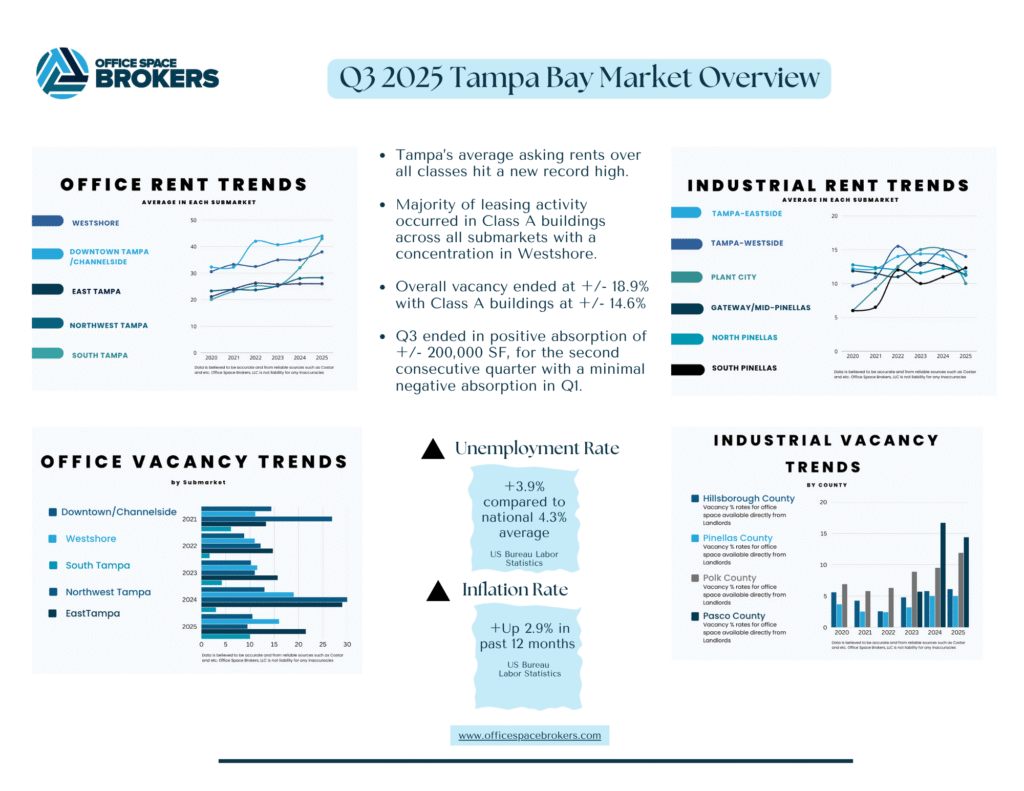
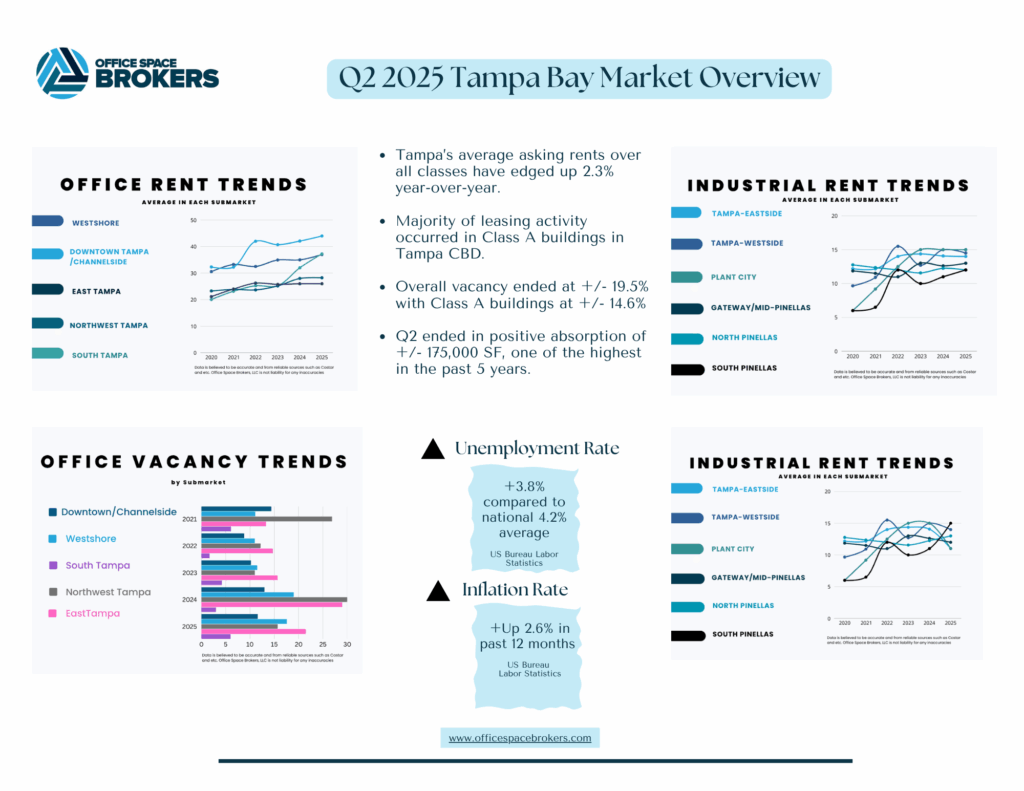
  • Tampa’s average asking rents over all classes have edged up 2.3% year-over-year, driven primarily by a 4% increase in Class A rates, compared to just a 1% bump for Class B assets. The pricing differential between urban and suburban Class A properties continues to widen.
  • Majority of leasing activity occurred in Class A buildings in Tampa CBD, which was primarily responsible for vacancy compression
  • Overall vacancy ended at +/- 19.5% with Class A buildings at +/- 14.6%
  • Q2 ended in positive absorption of +/- 175,000 SF, up from the negative absorption in Q1 and one of the highest in the past 5 years.

Let’s Talk Rent Numbers:

SubmarketOverall Average Asking Rent-All ClassesOverall Asking Rent Class A
Westshore$36.00 Sq. Ft.$42.66 Sq. Ft.
Downtown Tampa$42.80 Sq. Ft.$45.40 Sq. Ft.
Northwest Tampa$26.57 Sq. Ft.$27.56 Sq. Ft.
South Tampa$52.00 Sq. Ft.N/A
I-75 Corridor$25.00 Sq. Ft.$26.00 Sq. Ft.
Downtown St. Petersburg$39.55 Sq. Ft.$44.35 Sq. Ft.

New Construction Pipeline:

  • Midtown East: The Primary new office construction of 85,000 SF is the second phase of Midtown Tampa, mixed use project located in the heart of Tampa. 50,000 SF has already been preleased.
  • Ybor: 95,000 SF for Grow Financial in Ybor broke ground

2025 3rd Quarter Forecast:

What does this mean for Tenants?

Advantages:

  • Companies who desire to be in suburban areas such as Northwest Tampa in near Hillsborough Avenue/ Veterans Expressway and Carrollwood and I-75 Corridor,  have more negotiating leverage on rental rate and lease concessions due to the higher vacancy rates in buildings.
  • Tenants in the 10,000 + Square Foot range have a stronger position across all Submarkets when negotiating with Landlords.

Challenges:

  • Flexible work schedules with a mix of in office and work from home, continues to be a work in progress as companies evaluate what is best for their team. Every industry is different and everyone company is different.
  • Class A rents are forecasted to continue to increase
  • The continued shift of focusing on strategic office location with surrounding amenities and environment that compel employees to want to come into the office can drive companies to the same Submarkets and buildings, creating vacancies in less desirable buildings and competition in others.

Considerations:

  • Due to low vacancy in a submarket like Tampa CBD, allow plenty of lead time before a lease ends is vital when considering a relocation or expansion.
  • Evaluating submarkets outside of Westshore or Tampa CBD, will provide more favorable rental rate and lease terms. 
  • If Tenants are finding themselves in place of uncertainty for their office space, Coworking solutions have become very common in Tampa Bay, providing a mix of individual offices and conference rooms to be used for monthly and quarterly meetings.
  • Tenants who want to subleasing their space, positioning the space below market rent and free rent will position the space to be the frontrunner with competitors. 

What does this mean for Landlords?

Opportunities:

  • Landlords with buildings located in Downtown Tampa Core or Westshore Business District, with onsite and nearby amenities should experience the most leasing activity and ability to be more selective when evaluating Tenants.
  • Tenant’s who have experienced the dramatic rent increases and leases are coming up for renewal, could now be priced out of Tampa CBD or Westshore. Outlying areas such as Northwest Tampa, may benefit. 

Challenges:

  • Buildings located in suburban corridors like the Northwest and i-75 are experiencing the highest vacancy rates with companies minimizing their office footprints and focusing on prime locations.

Considerations:

  • Landlord’s in high vacancy areas, can offer additional incentives for Tenants with shorter lease terms, higher Tenant Improvement allowance and rent abatement to incentivize companies to consider a building and location they typically would not.
  • Frequency of office space use and operational layouts are being reimagined and repurposed, consider providing conference room space for Tenants who only need use of a conference room on a monthly or quarterly basis.

Chelsea Drinkard No Comments

Why You Need A Commercial Real Estate Broker To Represent You, Even When You Know The Landlord

Venturing into a new office space lease can feel intimidating. There are so many questions you may have, concerns about things unknown. That’s why having a Commercial Real Estate Broker working on your side is crucial to a successful journey in finding your next office space for rent in Tampa.

Landlords will always have their best interest in mind as the owner and investor of the building. Brokers, on the other hand, are working with your best interest in mind. Even when you have a good working relationship with the Landlord, they are still focused on protecting themselves and their property first and foremost at the end of the day. You could be in a position of thinking you are getting a pretty good deal on your lease and your commercial property for rent in Tampa but are you really? Here are a few things to consider:

Are you aware of current marketing conditions, concessions by Landlords and standard business terms? 

Do you have comparisons to a deal on the table with other possible small office space for rent in Tampa?

When you have concerns about a potential space, who is going to give you honest feedback and real insight about what will work best to meet your real estate needs?

When you don’t have the full overview of the Tampa Bay real estate market, it’s nearly impossible to really get the best possible lease. That’s why having the right Broker can educate you on the market as a whole and advise on business points they are experiencing and seeing at competing properties. Understanding what is a market norm is very important in negotiating a commercial lease and choosing which Landlord to have a long-term business relationship. 

Commercial Real Estate Brokers are also skilled in negotiating terms. They will seek to get you the office space of your dreams with a lease and terms that are not full of deal breaking concessions. Your Broker will help ensure that you are not paying exorbitant Common Area Expenses, hidden fees and other thumbs-down terms but instead that you are treated to a fair lease with all the amenities, parking spaces and square footage you need.

When you need an office space, you need Office Space Brokers.

Chelsea Drinkard No Comments

3rd Quarter 2023 Tampa Bay Office Market Report and Q4 Forecast

Important Highlights:

Tampa Bay:

Office Market:

  • Majority of activity and demand has been focused on Westshore and Central Business District (CBD) vs the suburbs which is consistent with the flight to quality trend by Tenants.
  • Class A buildings made up of over 60% plus of leasing activity in Q3 over the suburban areas.
  • Asking rents in Class A Buildings have increased by +/-6%
  • Direct asking rents are up 1% and Class A and B building in the Westshore and CBD areas for the third quarter in a row.
  • Vacancy rate in Tampa CBD is 13% and Westshore in 18%.

Let’s Talk Rent Numbers:

Submarket Overall Average Asking Rent-All Classes Overall Asking Rent Class A
Westshore $33.50 Sq. Ft. $37.01 Sq. Ft.
Downtown Tampa $40.00 Sq. Ft. $41.80 Sq. Ft.
Northwest Tampa $26.75 Sq. Ft. $27.90 Sq. Ft.
South Tampa $34.50 Sq. Ft. N/A
I-75 Corridor $26.50 Sq. Ft. $27.50 Sq. Ft.
Downtown St. Petersburg $33.40 Sq. Ft. $36.00 Sq. Ft.

Building Highlights:

  • Gas Worx: Ybor City real estate investor Darryl Shaw’s Gas Worx is a mixed-use development remaking older industrial and vacant properties between Ybor and the Channel District into a walkable area. The first phase, including 317 apartments and retail space, began construction in October and is set to open in spring 2024. A second apartment community with 370 apartments and retail will begin construction later in 2023. At full build-out, Gas Worx is planned to have nearly 5,000 residences, 140,000 square feet of retail, and 500,000 square feet of office space.
  • Ybor Harbor: Adjacent to Gas Worx, Darryl Shaw has unveiled plans for Ybor Harbor, a 33-acre mixed-use waterfront development on Ybor Channel south of Adamo Drive. The project aims to connect Ybor to the Channel District and downtown and will include up to six million square feet of residential, office, hotel, and retail space. Plans also include the development of a public area with piers, boat slips, green space, and a boardwalk lined with restaurants and shops.
  • Tampa’s Riverfront: The development boom along downtown Tampa’s riverfront continues, with projects like the 31-story luxury apartment tower Arts and Entertainment Residences and the Pendry Residences Tampa luxury riverfront hotel and condominium tower. The Tampa Convention Center is also undergoing a $38 million expansion, adding new waterfront meeting and event rooms.

2023 4th Quarter Forecast:

  • Labor Market and Economic Indicators: The tight labor market is expected to remain steady, with the unemployment rate likely to be around 3.2%, similar to the previous quarter.
  • Job Creation: Tampa Bay is anticipated to continue as a front-runner in job creation across the state, contributing to further employment growth.
  • Supply: Overall vacancy rates are projected to remain low
  • Demand: Leasing is expected to be steady into fourth quarter with majority in focused in CBD and Westshore in Class A and Trophy buildings.

What does this mean for Tenants?

Advantages:

  • Increased rent concessions from Landlords: Higher Tenant Improvement allowance towards build outs and providing free rent to decrease overall lease value.
  • Favorable Economic Indicators: The low unemployment rate and steady job growth in Tampa Bay suggest a thriving economy. For Tenants, this means a potentially larger customer base and a higher likelihood of finding qualified employees in the area.
  • Sublease Options: Sublease options can provide favorable for Tenants who prefer a shorter lease term and below market rent especially for those looking for 10,000 RSF and up.

Challenges:

  • Turn Key Options: Construction costs are still record high and the lack of turn key “Spec Spaces” Landlords have available for Tenant’s who require immediate move can require Tenant’s to lease Suites do not provide the desired layout for Tenants.
  • Lead Time: Having timelines with buffer built in will give margin for continued slow construction timelines, for architectural drawings, permit approvals and supply chain issues.

What does this mean for Landlords?

Opportunities:

  • Low Vacancy Rates For Smaller Suites: Suites under 5,000 SF and under spaces are being leased quickly.
  • Turn Key and Spec Suites: Having turn key Suites under 5,000 SF for Tenants to quickly move into will provide a competitive advantage over other vacant competing Suites for Tenants who do not have enough lead time for long construction timelines.

Considerations:

  • Tenant Selection: Ensuring that potential Tenants have a strong financial standing and align with the property’s intended use can help minimize risks associated with tenant turnover or payment issues.
  • Tenant Retention: Attracting new Tenants is essential and Landlords should also prioritize Tenant retention. Historically, it is more cost effective to maintain a Tenant then marketing, leasing and Tenant Improvement costs to acquire a new Tenant. Maintaining positive Landlord-Tenant relationships and providing excellent customer service can help ensure Tenants choose to renew their leases, reducing turnover and associated costs.
  • Building Location: If buildings are located in Suburban areas outside of CBD and Westshore will have to be more aggressive with Concessions and adjusting asking rent.
Chelsea Drinkard No Comments

Operating Expense Reconciliation


What exactly is operating expense reconciliation, and why is it becoming increasingly important in the Tampa market?

As a Tenant in a commercial building in Tampa, you may be familiar with receiving an invoice from the Landlord for the reconciliation of the building’s operating expenses from the previous year. Typically, by May of each year, the Landlord will send you a notice with an invoice for any amount owed or a credit to your rent. If you are in a Full Service or Modified Gross lease, what are you receiving an additional invoice or credit in the first quarter of the following year?

Operating expense reconciliation is the process by which a Landlord calculates the actual operating expenses for a building over the previous year by reconciling the estimated budget expenses which were used for the Base Year of a lease compared to the actual expenses of the building for the previous year. The difference between the estimated expenses and the actual expenses is known as the “reconciliation amount.” If the actual expenses were higher than the estimated expenses, the Landlord will send an invoice to a Tenant for the amount due above the Base Year. If the actual expenses were lower than the estimated expenses, the Landlord will usually apply a credit of that amount to the monthly rent.

Why are operating expenses more crucial in the Tampa market? 

Hurricanes are a common occurrence in Florida, and the resulting damage can be significant and dramatically increase building insurance.  Hurricane Ian in 2022, insurance rates for commercial buildings in Tampa have been increasing dramatically over the past few years. Secondly, the value of commercial buildings has increased, especially in the City of Tampa, therefore so have the Real Estate Taxes. 

Landlords are responsible for holding an insurance policy on the building and passing on the cost of insurance to Tenants as a part of the building’s operating expenses. Depending on the type of lease you have, these pass-throughs will impact Tenants differently. A Full-Service lease, the rent includes the Tenant’s operating expenses, including insurance and are only responsible for the portion above your base year. 

If a Tenant has a Modified Gross lease with an Expense Stop, rent includes a certain amount for operating expenses that was agreed upon in the lease, and any expenses above that amount are passed on to the Tenant. For example, any increase in insurance rates will only impact a Tenant if the actual expenses exceed the expense stop.

How can Tenant’s prepare for operating expense reconciliation in the Tampa market? First and foremost, understand the terms of the lease and how the operating expenses are calculated. Always reach out to the Landlord or Property Manager with questions or concerns.

Consider negotiating the lease terms at renewal or when signing a new lease to establish the highest Base Year possible. For example, if you have a Full-Service lease, negotiating a cap on the amount rent can increase due to operating expenses. These caps often exclude non controllable expenses i.e. Real Estate Taxes and insurance but can still be beneficial. A Modified Gross lease, negotiating a higher expense stop can aid in avoiding additional pass throughs. 

Building operating expense reconciliation is a critical part of commercial leasing in the Tampa market, and it is becoming even more important due to the impact of hurricanes on insurance rates. Tenants must understand lease terms and how operating expenses are calculated. 

If your commercial lease is ending soon or questions on your operating expense pass through reconciliation, give us a call for a free consultation: 813-289-3700.


Chelsea Drinkard No Comments

1st Quarter 2023 Tampa Bay Office Market Report and Q2 Forecast

white and blue concrete building under blue sky during daytime

Important Highlights:

Tampa Bay:

Tampa Bay’s commercial real estate market is thriving, with a strong demand for office space, particularly in the downtown area. The growing population and job market in Tampa have contributed to the demand for office space, and many companies have relocated to the area in recent years. According to Forbes Tampa is ranked the number one city for small businesses and the number two emerging tech hub. 

  • Pinellas County
    • Industrial vacancy rate is 3.2%
    • $12.62 SF NNN flex/warehouse
    • $7.86 SF NN warehouse distribution
    • 258,068 SF under construction
  • Hillsborough County
    • Industrial vacancy rate is 5.2%
    • $13.98 SF NNN flex/warehouse is $13.98 SF
    • $7.04 SF NNN for warehouse distribution
    • 2,772,283 SF under construction

Office Market:

  • $35.40 PSF Class A Average
  • The direct asking rents for Class A Buildings. up Approx. 3.9% year-over-year
  • Vacancy rate got Class A Buildings is Approx. 10%
  • Turn-key spec office spaces that are move-in ready for companies with pressing deadlines continue to be in demand who do not have the time to wait for permitting and construction timelines. 

Let’s Talk Rent Numbers:

Submarket Overall Average Asking Rent-All Classes Overall Asking Rent Class A
Westshore $34.05 Sq. Ft.  $38.51 Sq. Ft.
Downtown Tampa $29.19 Sq. Ft. $31.95 Sq. Ft.
Northwest Tampa $27.65 Sq. Ft. $27.79 Sq. Ft.
South Tampa $21.00 Sq. Ft. N/A
I-75 Corridor $26.78 Sq. Ft. $26.99 Sq. Ft.
Downtown St. Petersburg $32.19 Sq. Ft. $31.55 Sq. Ft.

Building Highlights: 

  • Mixed-use developments continue to be at the forefront of new construction.
  • “Miami-based Related Group purchased 6 acres on the west bank of the Hillsborough River — what will become the Riverfront district. 
  • Ybor City developer Darryl Shaw is assembling roughly 25 acres of closely watched waterfront land along the Ybor Channel.
  • Strategic Property Partners, the developer of Water Street Tampa, has demolished the former Ardent Mills flour plant between the Channel district and downtown Tampa to make way for Water Street’s second phase.” Read more of the upcoming developments here. 

2023 2nd Quarter Forecast:

  • To sustain teamwork, camaraderie, and creative collisions, companies may adopt flexible schedules based on personnel who operate in the same teams or departments. 
  • Tampa Bay will continue to see out-of-state businesses migrate and expand to the area, and demand for under 5,000 SF office space could remain high.
  • The primary concern was the blurring of boundaries between home and work. As a consequence, throughout 2022, there was a gradual rise in the number of professionals opting for a partial return to the office, which persisted consistently month after month.

What does this mean for Tenants?

  • Tenants should evaluate what is the best long-term solution for their company, considering the well-being of the company and the possibility of a hybrid, remote, or in-office job. While vacancy rates in Tampa remain low, landlords may offer rent abatement and increased Tenant Improvement allowances due to high construction costs.
  • Tenants who delay office space matters until the last minute will find themselves at a disadvantage, with few alternatives and minimal, if any, leverage for negotiating based on construction timelines and competing availability.

What does this mean for Landlords?

  • Landlords must consider increasing Tenant Improvement allowances for construction expenses to provide basic building standards and Tenant-specific finishing to compete for the right Tenants.
  • Profit margins may be impacted by inflation, but increased rents and 3-4% annual increases can aid in the impact of inflation. Providing turn-key spec office spaces that are move-in ready for companies with pressing deadlines can help capture tenants.