
Share This Post With Your Friends
Economic Economic Performance & Employment Trends:
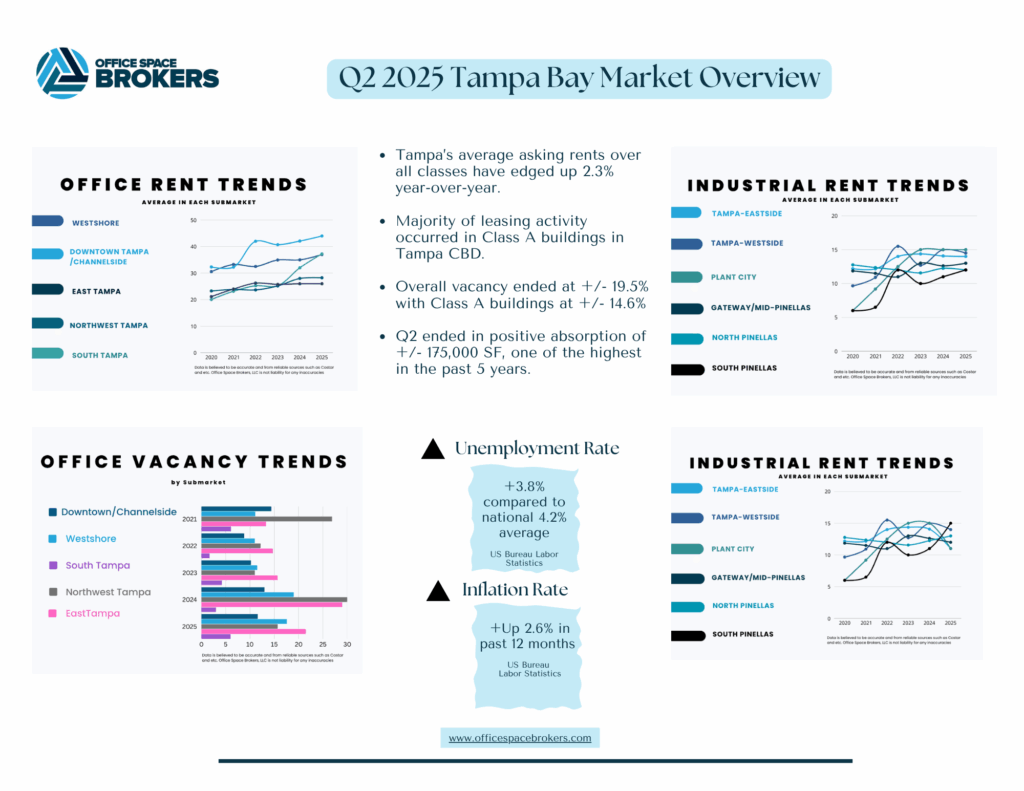
- Although Tampa Bay’s unemployment rate increased to 3.8% in Q4, it still falls below the national rate of 4.2%.
- “Tampa metro area added 15,500 jobs (+1.1%) in the private sector over the year in May 2025. The area gained the third-highest number of private sector jobs over the year in May 2025 among all metro areas. The area’s labor force was up 3,105 (+0.2%) over the year in May 2025. The industry gaining the most jobs over the year in May 2025 was education and health services, adding 5,200 jobs,” says the Florida Commerce.
- “Tampa ranks #1 in Financial Times-Nikkei’s for best places for foreign business in the US.”
- Inflation Rate was up 2.6% as of May 2025 over the past year via the US Bureau Labor Statistics.
Key Metrics in the Office Market:
- Tampa’s average asking rents over all classes have edged up 2.3% year-over-year, driven primarily by a 4% increase in Class A rates, compared to just a 1% bump for Class B assets. The pricing differential between urban and suburban Class A properties continues to widen.
- Majority of leasing activity occurred in Class A buildings in Tampa CBD, which was primarily responsible for vacancy compression
- Overall vacancy ended at +/- 19.5% with Class A buildings at +/- 14.6%
- Q2 ended in positive absorption of +/- 175,000 SF, up from the negative absorption in Q1 and one of the highest in the past 5 years.
Let’s Talk Rent Numbers:
| Submarket | Overall Average Asking Rent-All Classes | Overall Asking Rent Class A |
| Westshore | $36.00 Sq. Ft. | $42.66 Sq. Ft. |
| Downtown Tampa | $42.80 Sq. Ft. | $45.40 Sq. Ft. |
| Northwest Tampa | $26.57 Sq. Ft. | $27.56 Sq. Ft. |
| South Tampa | $52.00 Sq. Ft. | N/A |
| I-75 Corridor | $25.00 Sq. Ft. | $26.00 Sq. Ft. |
| Downtown St. Petersburg | $39.55 Sq. Ft. | $44.35 Sq. Ft. |
New Construction Pipeline:
- Midtown East: The Primary new office construction of 85,000 SF is the second phase of Midtown Tampa, mixed use project located in the heart of Tampa. 50,000 SF has already been preleased.
- Ybor: 95,000 SF for Grow Financial in Ybor broke ground
2025 3rd Quarter Forecast:
- Labor Market: Hiring expected to slow down and unemployment will remain under the national average
- Job Creation: Estimated net job growth: 12–18k new jobs and growth rate: ~1–1.5% quarterly (3–6% annualized)
- Supply: Based on the 5 previous quarters of decreasing vacancy rates, they are expected to continue to decrease.
- Demand: Class A office space is projected to continue to be the leader in leasing with the flight to quality trend remaining strong and companies being strategic with their office location and amenities. South Tampa and medical office in particular will continue to be in high demand.
- Economic Indicators: Insurance premiums and Real Estate Taxes continue both Tenants and Landlords, increasing building Operating Expenses with “new normal” highs.
What does this mean for Tenants?
Advantages:
- Companies who desire to be in suburban areas such as Northwest Tampa in near Hillsborough Avenue/ Veterans Expressway and Carrollwood and I-75 Corridor, have more negotiating leverage on rental rate and lease concessions due to the higher vacancy rates in buildings.
- Tenants in the 10,000 + Square Foot range have a stronger position across all Submarkets when negotiating with Landlords.
Challenges:
- Flexible work schedules with a mix of in office and work from home, continues to be a work in progress as companies evaluate what is best for their team. Every industry is different and everyone company is different.
- Class A rents are forecasted to continue to increase
- The continued shift of focusing on strategic office location with surrounding amenities and environment that compel employees to want to come into the office can drive companies to the same Submarkets and buildings, creating vacancies in less desirable buildings and competition in others.
Considerations:
- Due to low vacancy in a submarket like Tampa CBD, allow plenty of lead time before a lease ends is vital when considering a relocation or expansion.
- Evaluating submarkets outside of Westshore or Tampa CBD, will provide more favorable rental rate and lease terms.
- If Tenants are finding themselves in place of uncertainty for their office space, Coworking solutions have become very common in Tampa Bay, providing a mix of individual offices and conference rooms to be used for monthly and quarterly meetings.
- Tenants who want to subleasing their space, positioning the space below market rent and free rent will position the space to be the frontrunner with competitors.
What does this mean for Landlords?
Opportunities:
- Landlords with buildings located in Downtown Tampa Core or Westshore Business District, with onsite and nearby amenities should experience the most leasing activity and ability to be more selective when evaluating Tenants.
- Tenant’s who have experienced the dramatic rent increases and leases are coming up for renewal, could now be priced out of Tampa CBD or Westshore. Outlying areas such as Northwest Tampa, may benefit.
Challenges:
- Buildings located in suburban corridors like the Northwest and i-75 are experiencing the highest vacancy rates with companies minimizing their office footprints and focusing on prime locations.
Considerations:
- Landlord’s in high vacancy areas, can offer additional incentives for Tenants with shorter lease terms, higher Tenant Improvement allowance and rent abatement to incentivize companies to consider a building and location they typically would not.
- Frequency of office space use and operational layouts are being reimagined and repurposed, consider providing conference room space for Tenants who only need use of a conference room on a monthly or quarterly basis.
Share This Post With Your Friends